The Steam Deck is the Best Product Ever


Almost two years ago, I logged onto Steam and bought a Steam Deck on a whim. It made a huge impact on me. While the honeymoon phase is long over, I still think it’s one of the best products out there. Let me tell you why.
“Function” Over “Everything Else”
When I was a young lad, I played my “fair share” of video games. It served as a great way to make friends, learn new things (coding, ultimately), mature through unique emotional experiences, and of course, escape the all-encompassing pit of despair (AKA, my grades). However, no basement gremlin is whole without their signature “battlestation”.
My weapon of choice? A $500 Dell laptop.
Much to the chagrin of every PC shop employee I asked (who insisted I needed an Alienware), this laptop did exactly what I needed it to. The low-end graphics, paired with the equally mediocre ~720p display made for passable gameplay on AAA titles (at the lowest settings, of course). This works because 720p is a relatively low resolution, meaning your computer works less to paint a picture on your screen. While the vagrant Best Buy employees called me a madman, it turns out I was onto something… This is exactly how the Steam Deck was designed.
Good Enough is Perfect
— Me
The Steam Deck is the modern handheld equivalent to my laptop. It sports a similar ~720p display, and pumps out enough frames to make you say “yeah, that’s good enough”. How “good” is “good enough”? If we assume 4K to the modern standard of this proclaimed “age of 4K gaming”, a 720p image has 1/16th as many pixels as a 4K one. A 16x performance boost is enough to turn any toaster into a turbocharged gaming machine*.
*This isn't completely accurate anymore, especially with the advent of newer display & upscaling technologies. As well, "modern" games tend to suffer from seemingly ever-growing, truly biblical levels of CPU & GPU overhead. In practice, this means that computers with lopsided hardware configurations will have wildly inconsistent performance across different titles.To be clear, the Steam Deck can run plenty of games at higher resolutions, but there’s a reason Valve opted for 720p as the default. It’s the sweet spot between performance, battery life, and thermals. Besides; this is a handheld, not a competitive rig. I can play Terraria for 5 hours on a single charge.
Portability is King
A few years after I had my laptop, I got my first part-time job, pushing carts at Safeway. Not long after I started counting my pay stubs, I made the jump to a self-built gaming PC 😎. As soon as I slotted in that GPU for the first time, I immediately knew that I had sipped the Cool-Aid. Unfortunately, the writing was on the wall; casual gaming would be largely gatekept to my bedroom. This wasn’t a huge deal for me, as I was driving myself to and from work & school anyway… Or so I thought.
As the years went on, I spent less time getting out, spending time with my parents at their cabin, or even going on trips with friends. Fast forward even further, and several OCD-adjacent struggles shifted me away from playing games entirely, and into productivity & coding (often on an unhealthy level). I had become constrained to my room even harder, and for a reason I didn’t even understand anymore.
–That’s where the Steam Deck came in.
I used games as an excuse to get away from the computer entirely, and suddenly I had a whole library at my fingertips again. It was exhilarating, but the feeling never went away. For a short while, I wanted to get out, just so I had an excuse to bring my Steam Deck with me. I’d whip it out at the most random places, looking like a complete loser, but I didn’t care. It actually cured my mental health (at least part of it).

Priced to Sell
If you’re not into the economics of gaming hardware, I’ll give you the Cliff’s notes:
- The self-proclaimed fight is labeled “PC vs console”
- PC refers to “personal computer” (desktop/laptops, usually running Microsoft Windows)
- Console refers to dedicated gaming products (Sony Playstation, Microsoft Xbox, Nintendo Switch, etc.)
- Consoles are historically cheaper than PCs
- Loss leaders
- Consoles are sold below cost, because the company has a monopoly on the games sold for it
- Same strategy is how HP sells shitty printers for cheap, Apple charges commission on every app sold on the App Store, etc.
- No such monopoly exists for PC games
- Economies of scale
- Consoles are mass-produced (units in the millions), meaning the cost to make each unit is lower
- PCs are sold as components, or pre-built systems from systems integrators (units in the thousands)
- Loss leaders
TL;DR: Console manufacturers make money on games, PC manufacturers don’t.
The Steam Deck has one unique advantage in this regard: it’s made by Valve, the company behind Steam, the largest digital distribution platform for PC games. This gives Valve the unique opportunity to sell a device under the same economics as a console. This observation isn’t just anecdotal either; the Steam Deck is built “like a console”:
- Generation-old hardware (AMD APU based on 2017 architecture)
- Custom operating system (SteamOS, based on Linux)
- Self-contained manufacturing (designed & built by Valve)
This puts starting price of the Steam Deck at a mere USD$399, rivalling the famously underpowered Nintendo Switch (starting at USD$299). The key difference is that Steam is Steam. Valve doesn’t force you to buy remasters or ports of your existing library, every time a new console generation comes out. A fool might say, they are passing on the savings to the consumer.
There are of course other options that can run Steam or SteamOS, thanks to system integrators like Asus, GPD, and Aya, Lenovo, and Razer. Most of their handhelds feature more iterative hardware, better performance, and admittedly less polish. Considering these as a direct alternative to the Steam Deck, you would essentially pay an extra $200-$400 for up to 2x the performance. This kind of price jump from a $400 device is…not unexpected, given their circumstances.
Can We Fix It?
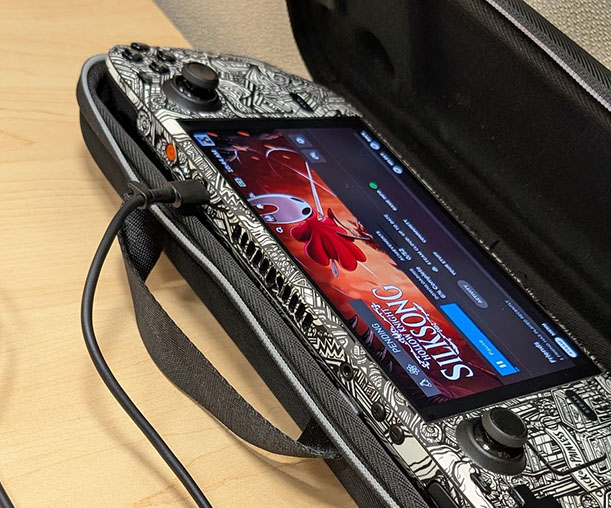
All major components (aside from the motherboard) are available for purchase from iFixit at affordable prices. What a breath of fresh air…
The Experience
It’s worth noting that the SteamOS experience is far smoother than the Windows experience, but still a cut below the modern console experience.
- Games aren’t custom built/optimized for the Steam Deck
- A small percentage of games simply won’t run
- There’s no guarantee that your favorite games will run well
To me, someone who’s never launched a video game without looking at the settings menu first, this is business as usual. I, however, also understand that this is a huge barrier to entry for most people, especially console gamers.
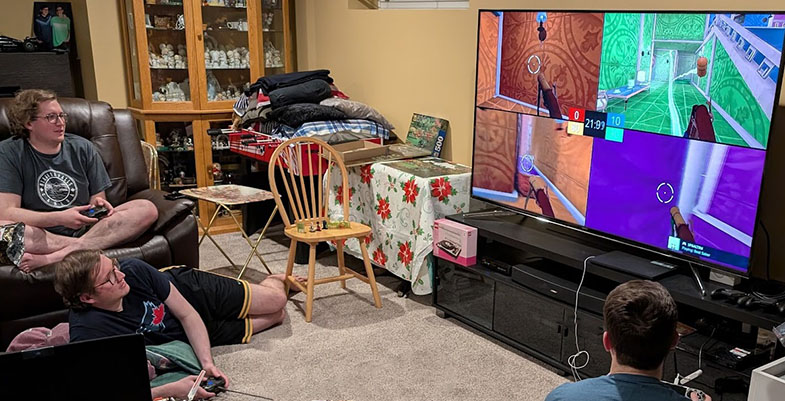
What it lacks in polish, it makes up for in flexibility. You can install Windows, Linux, emulators, other digital storefronts, and even use it as a regular computer (with a keyboard/mouse/monitor); this is something no other console does (except for the old PlayStation 3). I regularly run Minecraft Java Edition and Zenless Zone Zero on it through third party launchers (with a bit of tweaking). I regularly hook it up to a TV at parties and play local co-op games with friends.
Should You Buy One?
With the Steam Deck 2 rumored to be a year or two down the road, and the GabeCube being just around the corner, is it still worth buying a 3yo Steam Deck today?
If you’ve sopped enough of my rambling, you should understand that my Steam Deck was not a “treat” or an “upgrade”, but rather a lifestyle change. Many people have had similar revelations about “portable gaming” after buying a Nintendo Switch, so this was just my version of that.